

How to Pass the California Contractor Exam: Study Tips and Test-Day Strategy
Study preparation • Exam day • How to make an educated guess
By Thompson Learning. Testing information checked October 13, 2026.
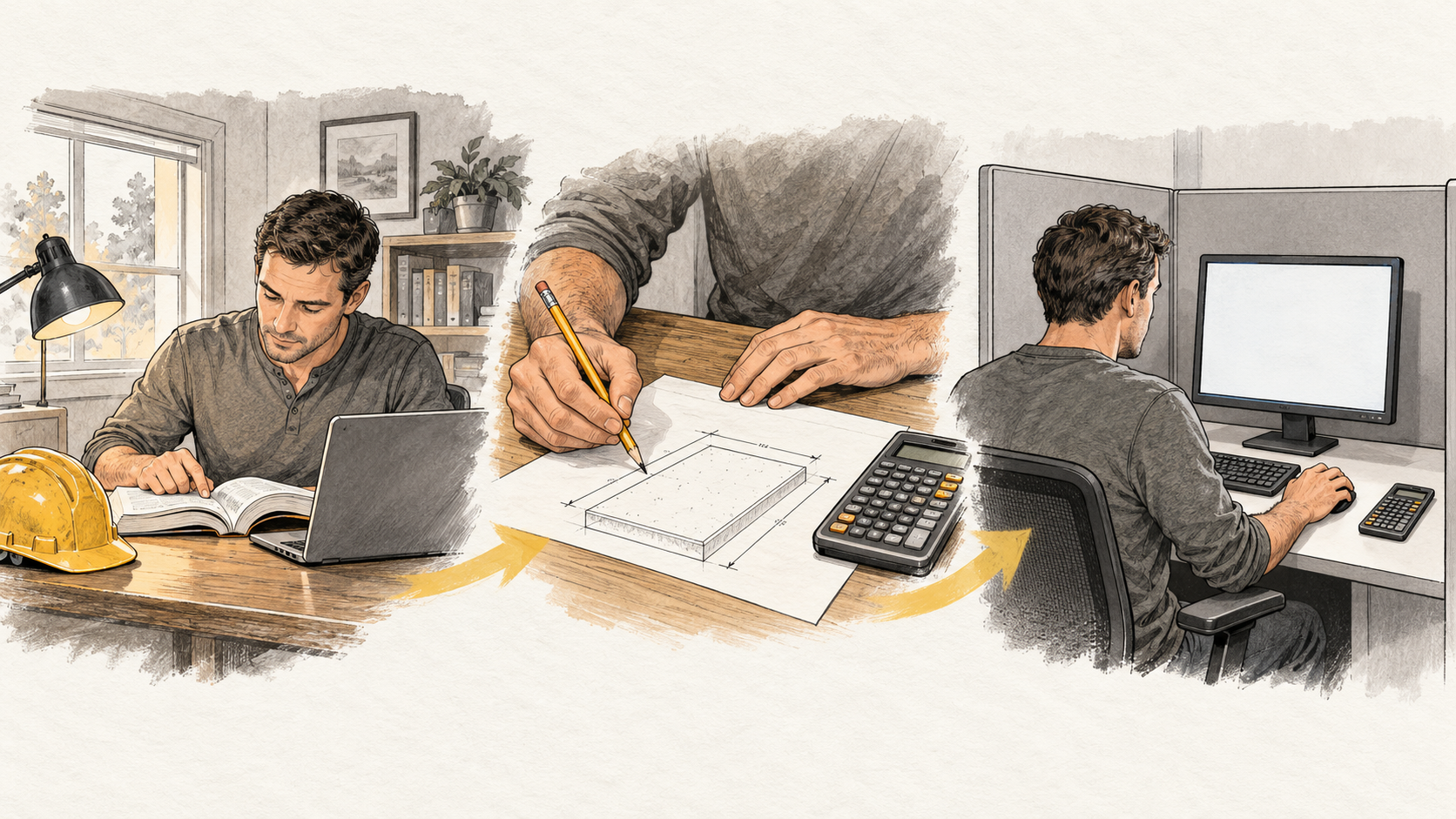
You may know your trade well and still find an exam challenging. A test asks you to work through unfamiliar wording, calculations, and topics you may not use every day—all while watching the clock.
At Thompson Learning, we recommend building a repeatable study routine and practicing how you will handle the exam. This guide separates study preparation before your appointment, strategy on exam day, and educated guessing when a question leaves you unsure.
Part 1: Study Preparation
Use this part before your appointment to decide what to study and turn practice results into a plan.
1. Start with your exam outline
Download the current CSLB study guide for your classification and the Law and Business guide if that exam is required for your application. The guides list exam topics, their approximate weighting, sample questions, and reference materials. Use that outline to decide what to study.
Mark each topic confident, needs review, or unfamiliar. Give extra time to weak areas that represent a substantial part of the exam. Keep Law and Business preparation on its own list so it does not disappear behind trade practice.
Your goal is to explain a rule, recognize when it applies, or complete a calculation without seeing the answer first. Being comfortable with a familiar question is a useful start; being able to solve a new version is a better check.
2. Make each study session active
Choose a repeatable time that fits your work and family responsibilities. A focused 45-minute session is one workable starting point. You can shorten it on a busy day or add another session with a break when your schedule allows.
- 5 minutes: recall. Without opening your notes, explain a few points from the previous session or solve a short problem.
- 15 minutes: learn. Work through one manageable topic in your study guide or lesson. Note the rule, steps, or formula that matters.
- 15 minutes: apply. Close the lesson and answer practice questions. Write out calculation steps instead of guessing from the choices.
- 10 minutes: review. Check the explanations, record the reason for each mistake, and choose what to revisit next.
Use our study guides and video or audio lessons to understand the topic, then use flashcards and practice questions to check what you can recall. Rewatching a lesson is most useful when you have identified the exact part you do not understand.
You do not need a rigid Monday-through-Friday rule. Put sessions on your calendar, make room for rest, and adjust the plan when work changes. Consistency comes from a schedule you can actually keep.
3. Keep an error log, not just a score
A practice score tells you how many answers you got right. An error log tells you what to fix. Include questions you answered correctly by guessing; those topics still need attention.
| Topic | What went wrong? | Next practice |
|---|---|---|
| Concrete volume | Used inches as feet. | Convert all dimensions first, then solve two new volume problems. |
| Procedure or rule | Remembered the action but missed the condition that triggers it. | Write an “if this, then that” summary and test it with a different scenario. |
| Question wording | Missed the word EXCEPT. | Restate what the question asks before choosing an answer. |
For every missed question, ask: Did I lack the knowledge, misunderstand the question, use the wrong method, or make an arithmetic error? Correct the cause and try a fresh question later. Repeating the same test until you remember its answers can hide a gap in understanding.
4. Practice with a clock before test day
Take a timed practice exam after you have covered the main topics. Work without your lesson notes and review the answers after the session. Record where you lost time as well as what you missed.
CSLB allows 3.5 hours for each exam. Before starting, use the displayed question count and time limit to set a rough pace and reserve some time for review. If Law and Business and your trade exam are scheduled on the same day, plan for two separate testing sessions. See the CSLB exam FAQ.
Practice scores are feedback, not a promise of a passing result. Look for improvement across different questions and topics. If a subject repeatedly causes trouble, return to its lesson before taking another full practice exam.
Part 2: Exam Day
Use this part for check-in, pacing, reviewing your work, and submitting the exam. Part 3 explains how to handle questions you cannot answer confidently.
1. Prepare your test-day logistics
A few days before the appointment, review your error log and the topics that still need work. Keep the final evening manageable so you arrive rested rather than trying to cover the entire course overnight.
- Confirm the appointment: check the date, time, address, route, and parking arrangements in your PSI notice.
- Arrive at least 30 minutes early: allow time for check-in and identification procedures.
- Bring accepted identification: follow your notice’s requirements and make sure the name matches your registration.
- Plan for a closed-book exam: personal books, notes, calculators, phones, and watches are not permitted in the testing room. Follow the instructions for storing belongings.
- Arrange accommodations in advance: follow CSLB and PSI procedures before the appointment if you need an approved accommodation.
The CSLB/PSI General Building examination information guide explains check-in, security, and restroom procedures. A restroom break requires the proctor’s instructions and sign-out/sign-in procedures; do not assume you can leave freely or that every break adds testing time. Use the current instructions for your own exam and location.
2. Use two passes, then a final check
Use the computer tutorial to learn how to select answers and review questions before the timed exam begins. The PSI guide allows up to 15 minutes for the tutorial, outside the exam time. Ask the proctor about equipment or navigation problems.
First pass: work steadily
Read the whole question and all the choices. Answer questions you can solve efficiently. If a question takes too long, choose your best current answer and use the review feature explained in the tutorial to identify it for another look.
Do not spend several minutes debating one item while leaving easy questions unseen. Check the timer periodically and keep moving through the exam.
Second pass: return to the difficult items
Use the remaining time for calculations and questions where careful comparison could resolve the uncertainty. Restate the question, check the facts given, and compare the remaining choices. Finish with a check for unanswered questions before submitting.
Change an answer when you find a specific reason: a missed word, a calculation error, or a rule you can now apply correctly. An answer is not protected because it was your first choice, and it should not change merely because you feel nervous.
3. Check before you submit—and use your results
- I have selected an answer for every question.
- I have revisited the questions I marked for review.
- I have checked units and decimal placement in calculations.
- I have reread questions containing NOT, EXCEPT, MINIMUM, or MAXIMUM.
- Any answer I changed has a specific reason behind the change.
CSLB provides your result after the exam. If you do not pass, the report identifies how you performed in the topic areas. Use that feedback to revise your study plan. If you pass, follow the remaining licensing instructions: passing the exams does not itself issue your license. The CSLB exam FAQ explains these next steps.
Part 3: How to Guess
Learn this method during practice, then use it on exam day when you are unsure which answer to select.
1. The best way to guess: narrow the choices
The official General Building and Law and Business study guides describe four choices with one best answer and no penalty for guessing. Select an answer for every question. When you are unsure, use what you know to make the most informed choice available.
Use this sequence: read the task → predict → eliminate → compare → choose and move on. You do not need to remember every detail to improve a guess. A known unit, a required first step, or a condition stated in the question may be enough to rule out an option.
- Read the exact task. Restate it in a few words: “Find the minimum,” “Choose the first step,” or “Identify what is NOT permitted.” Notice the person, work stage, conditions, and units. An answer can be true in general and still fail to answer this question.
- Predict before choosing. Recall the relevant rule or procedure, or estimate the size of the answer. Even a rough expectation—“I need a volume, not an area”—gives you something to check the choices against.
- Eliminate only with a reason. Reject an option when it contradicts a stated fact, uses the wrong units, applies to another situation, or puts the steps in the wrong order. On a safety question, match the control to the stated hazard. On a Law and Business question, check whose responsibility or which stage of the process is being asked about. Keep an unfamiliar option in consideration unless you can explain why it is wrong.
- Compare the remaining choices directly. If two look plausible, identify the exact difference between them. Which one answers the question under the stated conditions? A useful action that comes later does not answer “What should you do first?” Avoid adding facts the question did not give you.
- Choose the best-supported answer. If another reread produces no new clue, select your best current choice, mark it for review using the exam’s review feature, and continue. Return if time remains. Change the answer when you find a concrete reason, such as a missed condition or a calculation error.
What if you still have no idea?
If you have no basis for favoring one remaining choice, choose among those options and move on. No letter has an inherent advantage. Do not switch because you have already selected several Bs, assume the longest answer is correct, or choose a middle numerical value because it looks safer.
For a random choice, four options give a 25% chance. Correctly eliminating one wrong option leaves about 33%; eliminating two leaves 50%. These are mathematical odds, not an estimate of your personal knowledge. They apply only if the correct answer remains among the choices you kept.
Words such as “always” and “never” can help you test a statement, but they do not automatically make it false. Likewise, two similar or opposite answers do not prove that one of them is correct. Check meaning and conditions.
Example: choose the answer that fits the task
Original practice example—not an actual CSLB exam question.
Two suppliers quote materials for the same project using different quantities and units. What should you do first to compare the material prices fairly?
A. Choose the quote with the lower total.
B. Match the material specifications and quantities, express them in the same units, and compare the prices.
C. Compare the productivity of the installation crews.
D. Ask which supplier offers longer payment terms.
Think through the elimination: A treats different quantities as comparable. C answers a labor question. B and D both sound useful in business, but D addresses when you pay; B establishes what you are paying for. B best answers the stated task. Its greater length is incidental—the comparison method is what makes it correct.
2. Use an estimate to improve a numerical guess
For a calculation, convert the units and estimate before comparing the choices. You may be able to reject impossible answers even when you cannot complete every step confidently.
Original practice example—not an actual CSLB exam question.
A rectangular concrete slab is 18 feet long, 12 feet wide, and 4 inches thick. Ignoring waste and assuming uniform thickness, how many cubic yards of concrete are required?
A. 2.67 cubic yards B. 8 cubic yards
C. 24 cubic yards D. 72 cubic yards
Use what you remember: 4 inches is one-third of a foot, so the volume is 18 × 12 × ⅓ = 72 cubic feet. If you forget the cubic-yard conversion, reconstruct it: a yard is 3 feet, so a one-cubic-yard box holds 3 × 3 × 3 = 27 cubic feet.
Estimate a range: 2 cubic yards contain 54 cubic feet; 3 contain 81. Your 72 cubic feet falls between them, so the answer must be between 2 and 3 cubic yards. Only A fits. You can select it without calculating the exact decimal.
The full calculation confirms the estimate:
18 × 12 × ⅓ = 72 cubic feet
72 ÷ 27 ≈ 2.67 cubic yards
B ignores the thickness; C divides cubic feet by 3 instead of 27; D stops at cubic feet. Here, units and an estimated range resolve the uncertainty. Choosing a middle-number answer would be wrong.
If two choices remain within your estimated range, your estimate alone cannot separate them. Refine the calculation if you can, or choose the better-supported option and return later. Include waste allowances and other adjustments only when the problem calls for them.
Put the plan to work with Thompson Learning
Use our trade and Law & Business study materials to work through the outline, practice the topics you need, and review explanations after each session. We also include expert application review and assistance. If you are unsure which course fits your classification or application stage, call 866-685-8564.
Explore our General B exam-prep course, or use our contractor-school comparison guide to decide what support you need.