
C-10 Contractor License vs.
California Electrician Certification
Choose the right credential, application, and exam
Thompson Learning’s Un-Official Guide · Checked October 15, 2026
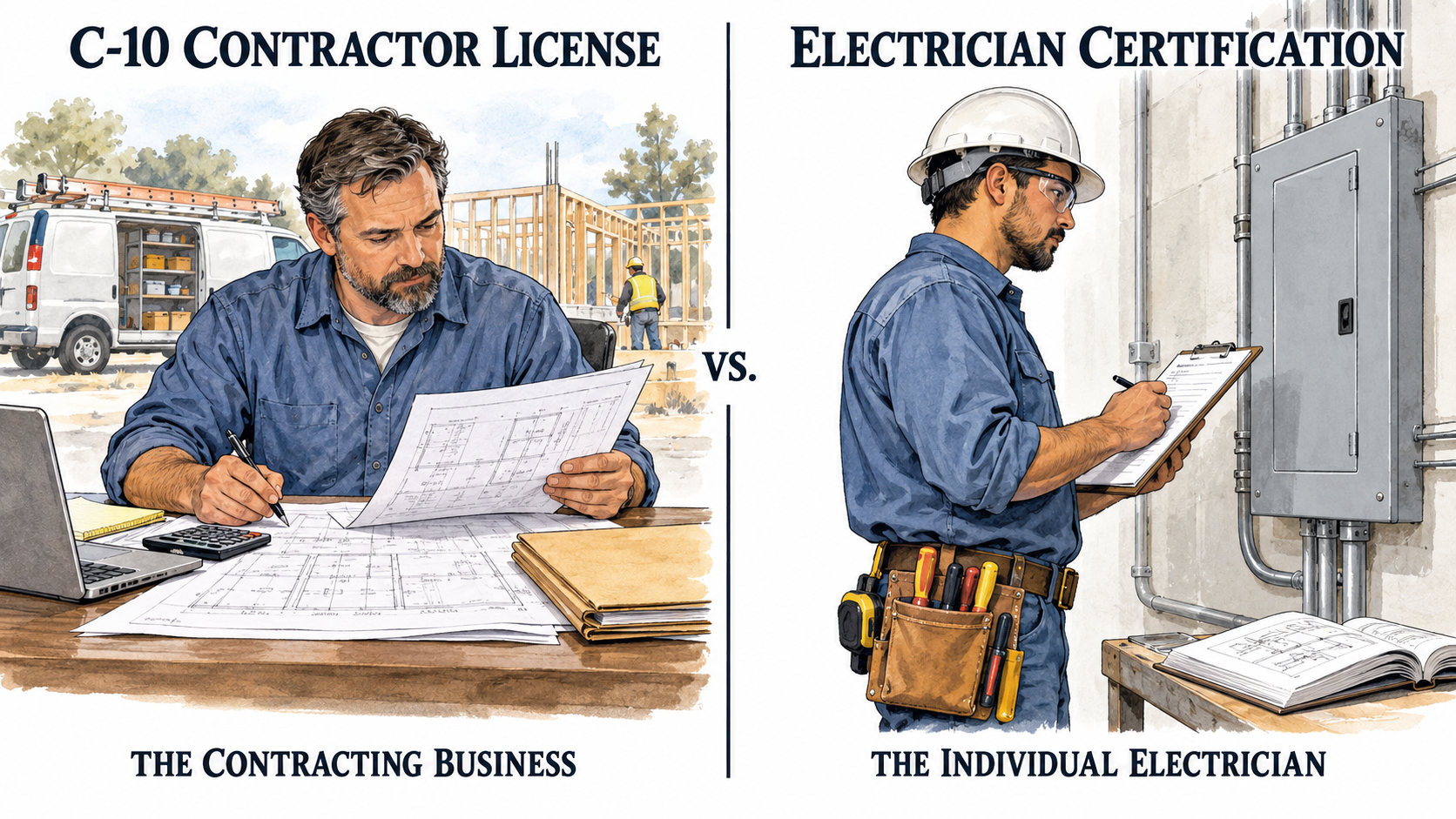
A C-10 contractor license authorizes an electrical contracting business. California electrician certification is an individual worker credential. If you want to run the business, start with CSLB’s C-10 requirements. If you want to work as an electrician for a C-10 contractor, start with DIR’s certification requirements or a lawful apprentice or trainee route.
Both paths involve electrical knowledge, but they have different applications, experience rules, and exams. Choosing the right one before you buy a course can save you time and money.
Ready to prepare? Explore our C-10 Electrical contractor exam-prep course or California electrician certification exam preparation, depending on your goal.
C-10 license vs. electrician certification at a glance
| Question | C-10 contractor license | California electrician certification |
|---|---|---|
| Who issues it? | Contractors State License Board (CSLB). | Department of Industrial Relations (DIR), Division of Labor Standards Enforcement (DLSE). |
| Who holds it? | The licensed business, including a sole owner. A Qualifying Individual meets the qualification requirements. | The individual electrician, in an approved certification category. |
| What is its purpose? | Electrical contracting within the C-10 classification. | Covered electrician work for a C-10 contractor; it does not license an independent contracting business. |
| Which exam? | Usually Law & Business plus the C-10 Electrical trade exam, unless CSLB grants an applicable waiver. | The exam for the worker’s certification category, such as General Electrician or Residential Electrician. |
| Can I use references? | The C-10 trade exam is closed book. | Specified references are supplied electronically in the testing system. Personal books are prohibited. |
| Who handles testing? | PSI, after CSLB refers the application for testing. | CPS HR administers the program’s exams; approved candidates schedule through Pearson VUE. |
Testing arrangements checked October 15, 2026. Sources: CSLB licensing and Qualifier guidance, CSLB examination requirements, C-10 study guide, and DIR’s current testing information.
What the C-10 classification covers
C-10 is California’s Electrical Contractor classification. Its scope covers electrical wiring, fixtures, equipment, raceways, conduits, and related systems. Read the official C-10 classification description when checking whether it fits the work your business will contract to perform.
The license belongs to the licensed business entity. The Qualifying Individual, or Qualifier, is the person listed with CSLB who meets its experience and examination requirements and is responsible for the business’s construction operations. A corporation’s license and an employee’s certification card are separate records.
Which path fits your situation?
These fictional examples show how to choose a starting point. The work you will actually perform and the business you will work for matter more than the job title.
1. “I want to work for an electrical contractor.”
Maria wants a job installing electrical systems for a C-10 company. Her starting point is the appropriate electrician certification category or an eligible apprentice or trainee route. She does not need to start an electrical contracting business just to become its employee.
Next step: Review the DIR Electrician Certification Program, identify her work category, and check her eligibility.
For General or Residential Electrician exam preparation, see our California electrician certification course options.
2. “I’m certified and want to bid my own jobs.”
Alex holds General Electrician certification and wants to sign contracts directly with customers through a new electrical business. His certification card does not authorize that business to contract. He needs to address C-10 licensing, including a qualified Qualifier and the application and issuance requirements.
Next step: Use our original contractor license application guide. For work requiring a license, the business must be properly licensed before bidding. See CSLB’s rules before applying.
For the trade-exam study portion, explore our C-10 Electrical contractor exam-prep course.
3. “Our company has a C-10. Does everyone need a card?”
Rene is the listed C-10 Qualifier for an electrical corporation. The Qualifier exemption permits Rene to perform electrical work for that licensed contractor without separate electrician certification. Sam is a nonqualifying officer who also works with the tools; the company’s license does not extend that exemption to Sam.
Ownership alone is not the test. A sole owner who is also the C-10 Qualifier can use the exemption for that licensed business. Other people performing covered work need their own certification or an applicable lawful training route.
Source: DIR’s “Who is required to be certified?” guidance, including Labor Code section 108.2(g).
4. “I have a C-10 and also work for another contractor.”
A C-10 license does not replace electrician certification when you perform covered electrical work as an employee of another C-10 contractor.
Bob is a hands-on foreman for ABC Electric, a licensed C-10 contractor. He also takes weekend electrical projects through his own C-10 business.
- For ABC Electric: Bob must hold the appropriate California electrician certification. Having his own C-10 does not exempt him from certification for that employee work.
- For his own customers: Bob needs an active C-10 license for electrical projects that require contractor licensing. His certification card does not authorize him to operate an electrical contracting business.
Know the licensing threshold: CSLB generally requires a license when a project totals $1,000 or more in labor and materials. A license is also required if the work needs a building permit or uses additional workers, even below $1,000.
Sources: DIR’s C-10 employee guidance and CSLB’s contractor licensing requirements.
5. “I’m starting out and don’t have the experience.”
Chris is new to electrical work. An exam-prep course will not create qualifying work experience or register Chris as an apprentice or trainee. Chris should investigate an approved apprenticeship or the registered Electrician Trainee (ET) route, with its school enrollment, registration, and supervision requirements.
Next step: Follow DIR’s trainee instructions and use the approved-school or apprenticeship resources linked there before paying for a program.
This guide focuses on C-10 contracting and work for C-10 contractors. Different exemptions and rules can apply in other employment settings. Check DIR’s coverage guidance for your actual work arrangement.
The experience requirements are measured differently
C-10: journey-level experience for the Qualifier
The standard CSLB requirement is four years of experience at journey level or higher in the classification, within the 10 years before applying. Qualifying work may be performed as a journeyman, foreman, supervising employee, or contractor. Education and completed apprenticeship training may qualify for credit under CSLB’s rules; CSLB decides the credit allowed. See its Get Licensed to Build guide, work-experience section.
Describe the electrical duties actually performed or supervised, give accurate dates and time worked, and choose a responsible Certifier with direct knowledge of that experience. Our Certification of Work Experience guide walks through that form with examples.
Electrician certification: category-specific eligibility
DIR has an approved apprenticeship completion route and an on-the-job experience route. The standard experience totals for the latter vary by category:
| Certification category | Required experience |
|---|---|
| General Electrician | 8,000 hours |
| Residential Electrician | 4,800 hours |
| Fire/Life Safety Technician | 4,000 hours |
| Voice, Data, Video Technician | 4,000 hours |
| Nonresidential Lighting Technician | 2,000 hours |
These are not unrestricted totals of any construction work. DIR defines qualifying activities, work-area requirements, and limits on hours credited in particular areas. For example, General Electrician experience must cover at least two specified work areas. Review Title 8, section 291.1 and the current application instructions for your route.
TLC-ProTip: don’t convert hours into eligibility automatically
“I have 8,000 hours” and “I meet CSLB’s four-year requirement” answer different questions. Trainee hours, journey-level work, part-time work, and education credits receive different treatment. Build your application around the requirements of the agency receiving it.
The exams require different preparation
CSLB C-10: closed-book trade knowledge
The CSLB C-10 study guide identifies planning and estimating, rough wiring, finish wiring, troubleshooting and maintenance, and safety as tested areas. It expressly identifies the exam as closed book.
Practice calculations, recognize safe installation methods, and explain why an answer is right without consulting a reference. A new Qualifier generally also needs Law & Business; do not assume electrician certification waives either CSLB exam. CSLB determines any waiver during its application review.
After referral for testing, follow the CSLB/PSI scheduling instructions. Passing the exams is one step; complete the remaining issuance requirements and confirm the license is active before contracting.
DIR certification: electrical knowledge plus reference navigation
The current July 2026 Electrician Certification Candidate Information Bulletin says permitted references are supplied electronically within the exam. You cannot bring personal books or outside materials. For General and Residential Electrician, it currently lists the 2023 NEC, 2024 NFPA 70E, and the Cal/OSHA Pocket Guide updated in 2022.
Practice recognizing the subject, finding the relevant rule or table, and applying it to the question. Learn the structure of the required references; merely memorizing where a sticky tab sits in a personal book will not reproduce the current exam interface. Check the bulletin for your category before choosing study references.
2026 testing update: use the correct booking path
DIR changed exam administration effective June 1, 2026. Its current scheduling page directs approved certification candidates through CPS HR and Pearson VUE. CSLB contractor exams continue through PSI.
Some older pages still mention the former certification testing arrangements. Follow the current bulletin and your eligibility notice so you book the right program.
Choose the course that matches the credential
A course labeled “electrical” may serve a completely different purpose from the one you need. Before enrolling, ask these four questions:
- Which agency and exam is this course for? California CSLB C-10, California DIR General Electrician, and an electrician exam in another state are different targets.
- Which references and editions does it use? Match the current official guide for that exam. The code used on a jobsite and the reference edition named in a testing bulletin may differ.
- What does the course accomplish? Exam preparation, approved trainee schooling, apprenticeship training, and continuing education have different purposes. A completion certificate alone does not establish all four.
- How will I practice? For C-10, include closed-book recall and calculations. For DIR certification, include accurate reference navigation as well as electrical principles and timed questions.
Our electrical exam study guide explains a practical study routine. Apply it to the correct California exam outline and references. If you are comparing contractor-prep options, use our contractor exam school comparison.
If you hold both, track both renewals
Renewing the C-10 business license does not renew an individual electrician certificate. DIR certification normally renews every three years; renewal requires 32 hours of relevant approved continuing education and 2,000 hours of industry work in the previous three years. See DIR’s renewal regulation and its continuing education provider guidance. Plan ahead of the expiration date and follow current renewal instructions.
Keep separate reminders for your business license, individual certification, and any trainee registration. Confirm that a renewal course qualifies for the credential you are maintaining.
Your next-step checklist
- Write down your goal: employee electrician, trainee/apprentice, or electrical contracting business.
- Name the exact credential: C-10 business license or a specific DIR certification category.
- Check eligibility before buying preparation: compare your experience and training with the current official requirements.
- Choose the right application and exam: use CSLB for the contractor license and DIR for electrician certification.
- Verify the right record: use CSLB’s license lookup for the business and the status resources on DIR’s certification program page for the individual.
If you are preparing for a C-10 application, continue with the Un-Official CSLB License Checklist. Once submitted, our what happens next guide explains the next steps.
Choose the preparation that fits your next step
Preparing to run an electrical contracting business? Explore our C-10 Electrical contractor course for the CSLB trade exam. Review the Law & Business requirement for your application as well.
Preparing for individual electrician certification? Our California electrician exam-prep page offers General Electrician and Residential Electrician course options.
Thompson Learning includes expert application review and assistance with its California contractor exam-prep program. Bring us the name of the credential you need and your questions so we can help you choose the appropriate preparation. CSLB and DIR make their own eligibility and approval decisions.
Prepared by Thompson Learning, an independent exam-preparation provider. Examples are fictional. Official sources and testing arrangements checked October 15, 2026. Use current CSLB and DIR instructions and your own eligibility notices when applying or scheduling.